Warning: This will be long
I've pondered upon the best way to approach writing about my trip to Africa and my mind always comes back to the khumbis. The what?! The debilitated, cramped, time-consuming public transportation of Swaziland. I remarked to Mia at one point, that we should calculate the percentage of my trip spent in one of these mini-buses. While we never got around to it, rest assured, it was a significant portion. Don't get me wrong, I loved riding in khumbis.
Swaziland is not big. It's half of the size of Kyushu, four times the size of Nagasaki prefecture, and not even 1.5 times the size of Los Angeles county- remember this is an entire country. I didn't have the chance to venture into the southern half, but I saw my fair share of the north through the windows of khumbis.
Public transportation in Swaziland is like none I've experienced before and I actually didn't really get it when it was first explained to me (and I'm still no expert). There are a few options, but I'll start out with the most straightforward.
The bus rank. In Mia's hut, I saw an indiscernible picture drawn by her 6-year old brother, Nsika, that said "bus rank." I assumed the words were as non-sensible as the drawing. In hindsight though, it was actually a pretty good drawing and labeled correctly. Depending on where you are the bus rank can be a very intimidating mad-house or a quite parking lot with some ladies selling goods. It's just a bus stop, pretty much. Khumbis are 16-seat, privately-owned (but for public use) minibuses. Each has a set origin and destination, often painted onto the van. You find the khumbi going to (or at least in the direction of) your desired location and grab a seat. Here's the sticky part, the khumbi doesn't leave until it's full. If you're the first person on, you could be waiting for a long time. My first trip, we spent longer waiting to leave, than it took to get to where we were going; 48 minutes for a 20ish minute ride.
So, I said it doesn't leave until it's full, and I meant full. Every seat filled and usually every nook and cranny crammed with stuff. I saw jugs shoved under seats, eggs, live chickens, huge bags of maize meal, children. Children are no exception. If they don't take up a seat, they ride for free, so babies and kids sit on laps or stand between seats. Don't even ask about seat belts...
Apparently, you're supposed to get a ticket on the khumbi. I don't think we got one the first 4 or 5 rides, but no mind, we still paid and we made it. Every khumbi has a driver and a "conductor," a guy that takes the money, (gives tickets) and tells people where to sit. I was really proud of myself when Mia and I were separated on one of my last khumbi rides and I paid for myself. It's cheap, by the way. Less than two bucks for a 40+ minute ride. (If you're on the side of the road and a khumbi going in your direction has already let someone off so has some extra seats is going by, you can wave them down and jump in from there, as well. )
The doors don't always close, the windows don't always open, but don't worry, the music will always be pumping. Almost every khumbi had a new stereo and the drivers just blasted their favorite tunes throughout the Swazi countryside. This is the closest I'll get to a good time to mention that many of the khumbi have a name- like a ship has a name. Some of them were pretty funny, like "Cup of Dreams."
So why did I like khumbi so much? Other than seeing the Swazi countryside, I saw the country people-side. There were so many interactions in, on, or around the khumbi that made it so memorable. What I learned on khumbis:
Swaziland has diverse, beautiful scenery: When I left the airport in Johannesburg, I saw what I pretty much expected of African terrain: flat and grassy. But the closer we got to Swaziland I saw a whole different world. Vast rolling hills, tall trees, lush vegetation. Granted it was rainy season so there was a lot of new growth. Later on in the trip, I saw the flat fields of maize and sugar cane. Apparently in the south, the terrain is even more different.
Swazis are friendly: Probably the story I've told the most thus far, occurred at my first bus rank. I'd been with Mia for maybe 45 minutes and we are standing in line for a specific khumbi and Mia starts chatting away in siSwati with this make (pronounced ma-ge, means "mother" or "woman old enough to be a mother"). I thought it was so weird that Mia happened to know this lady, even though we were no where near her community. They were laughing and joking. "Must be old friends," I thought. Nope, just some lady standing in the same line?! I was shocked at the time, but over the next week I realized that it really is just how the Swazis are: super friendly (and talkative). Everyone I met in Mia's community made me feel like one of the family instantly. It was weird and so different from Japan. In Japan everyone is very polite, and I realized that this can make them seem cold and standoffish.
People watch out for each other: Okay, this was neither in Swaziland nor on a khumbi, but it's related. As we crossed the border to Mozambique, we were a little worried about getting to the bus rank from the border gate, but we were taken under the wing by this nice Swazi woman. The trick to getting to the bus rank is to catch a ride on the back of a pick-up that makes trips back and forth from the gate to the rank. The back of this specific pick-up was run by one tough 13 year old boy, who was trying to charge us for 3 people, the third being our big bag full of camping stuff. So this woman got in this huge argument, just for us. Other passengers piped in in our favor as well, but in the end we still had to pay.
Again in Moz, but this time it was a khumbi, heading back to the border from Maputo- our big red camping bag was again the star of the story. This time, it was in the back of the khumbi, no problem except that the driver and conductor were talking about it, wondering whose it was, but only speaking in Portuguese! We had no clue! So this nice passenger, decided to ask us in English, just in case. What a pal! Things like this happened all the time. Anywhere from a simple translation like that to guiding me to a more direct khumbi and then helping me carry all of our stuff from one khumbi to another while Mia was out doing something else.
You can eat on the go: While it wasn't as bad as Maputo, there was quite a bit of trash on the ground around Swaziland, which made me sad. A lot of the litter, however, was maize cobs and mango peels, which is not so bad. It seemed that in every community you could find someone selling grilled maize and mangos (I think it's mango season). Unlike in Japan, eating on the go is fine here. Once you're done with the maize, just chuck the cob out the window of the khumbi. This was really hard for me to do that, especially on the right side, I was scared it would hit another car. Everyone else, including Mia, were seasoned pros.
Another favorite story involves eating maize in a khumbi. We were sitting in the back row and there was a big gogo (grandmother) between Mia and me. I was just picking at some leftover maize I had and the gogo saw it and asked me if it was maize. I took that as, "Can I have a couple kernels?" so I offered some. She readily accepted and took a few. A couple minutes later, she mentions the maize again, but this time, she takes the cob, breaks it in half and hands one half back to me, keeping the other for herself. I really didn't mind, it was just funny. We proceeded to throw the cobs out the window.
Swazis like their picture taken: Maybe it's because not many people have cameras, but so many Swazi people asked me to take their pictures. It was nice for me because I got some pictures of everyday people, but I still don't understand their logic, they're never going to see the photos. Another odd part of this is that when they want their photo taken, they yell out "Don't shoot! Don't shoot!" Again, counter intuitive.
Personal space is not a concept: I'm sure you've seen pictures or videos of Tokyo trains in the morning during rush hour, packed like sardines. Swaziland has this too on buses and sometimes khumbis. Especially in Mozambique, where we didn't ride any khumbis within Maputo (thank goodness). There, we saw khumbis packed until butts are hanging out of windows. The buses got pretty crowded too. We got on one early in the morning near the start of the line so it wasn't very full. By the time we got to our destination, an hour later, every seat was filled and every inch of aisle space was packed with people. Getting out was not easy, especially with a big backpack and that darn camping bag. I had to carry my backpack over the heads of seated passengers or it wasn't going to make it out with me!
TIA: This Is Africa. TIA is an acronym often used by volunteers. My biggest TIA moment was riding in a bus on the way to Hlane Royal National Park. We were just riding along looking out the window when all of the sudden there were 8 giraffe just hanging out on the side of the road. Wild giraffe! Hanging out on the side of the road! I was beyond excited. Moments later we also saw some impala and vultures!
Speaking of animals, I saw a ton. At Hlane, I went on 3 game drives (2 sunrise, 1 sunset). We saw rhinos, giraffe, impala, nyala, crocodiles, vultures, other big birds, warthogs, elephants (I got really close to some), hippos, a monitor lizard and some beautiful small birds. There is a lion section at Hlane as well, but unfortunately we didn't see any. The night we arrived they saw some lions feeding, but we'd opted not to do the sunset drive because lions are usually seen in the morning (oops!). The next two days however, the lions were nowhere to be seen. We saw their footprints and their leftover food, but no lions. It's especially hard during the rainy season because the grass is tall, there's plenty of watering holes and it's really hot (around 40C!) so the lions just lay around in the shade. Mia and I spent the daytime doing the same thing as the animals, just sitting by the watering hole watching as animals came and went. It was SO cool.
Another TIA moment happened at night when we were in the fenced off camping area, just roasting some marshmallows, when we heard a lion roar! It was awesome, but also terrifying because in the dark we could also make out forms of animals running INSIDE the camping area. Could it be that unimaginable situation like Jurassic Park when the predators get loose and cause havoc? Were we doomed to be lion food? When we heard the safari truck fire up and head out into the wild, it didn't help. "No! They're INSIDE!" we said to each other. We were pretty scared, especially because the lights of the truck showed the silhouette of an animal crouching near our tent, so we couldn't even take refuge. We sought out the help of our neighbors who were in the buildings so hadn't heard a thing, but they came with us back to our site, with a flashlight, probably thinking we were crazy. We realized that there were, indeed, animals next to our tent, but only impala- no lions. Mia and I are positive they were chased away from where ever they had been by a lion. I don't think lions can actually get out of their area though.
It's a small world: It's amazing that one second I was thinking "Man, this is a different world," then the next I ran into someone from Oxy. That's right. After lugging our stuff and that damn camping bag all over Swaziland and Mozambique, we were finally headed to our last stop before we got to ditch the bag. We got off a khumbi and hitched a ride on the back of a pick-up, but then had a 2+ kilometer walk ahead of us, down a straight, boring road. A car pulled over and this nice young couple, who happened to be going to the same hostel (there really wasn't anything else down the road), offered to give us lift. Turns out the woman is an '03 Oxy grad who worked there until '09, before she moved to South Africa. She was just in Swaziland for the holidays. Since she was there until '09, that means we were on campus together for 3 years! But wait, it gets weirder. Her roommate of 4 years (that alone is rare), visited her the year before and they went to the same hostel for new years as Mia and I were on our way to! Crazy!
My two weeks in Swaziland, Mozambique and Zambia were amazing. This is just a
sample of my experiences and stories, but if I try to write them all down, you may never see it. I recorded pretty much every waking moment in a journal, so as never to forget my experience.
It's hard to portray how I felt being there. It made me feel happy and sad, surprised and impressed, worried but hopeful. Just like every place, Swaziland has it's problems, probably more than it's fair share. While I know the volunteers can't solve these problems for the country on a whole, I was really impressed and amazed at the difference that Mia alone was making in her community on a personal level. I could tell that many many people's lives were changed by her being there.
Sorry it took so long to post this. I hope you enjoyed it. Don't forget to check out my photos:
Swaziland
Maputo, Mozambique
Zambia
Omuran-chan is a doll of the mascot of my town. I took her around Africa and not only showed her to kids there, I took pictures of her to show to my students. Seeing Omuran-chan in the photos really engaged my students more. They loved it! But were a little upset that I ended up trading her for a bag in Zambia on my last day. But hey, now she lives in Africa!
Sunday, February 17, 2013

Friday, December 7, 2012
Nabe
To my displeasure, winter has arrived. In my opinion there are only 4 good things about winter:
1. mikan- clementines, which are much more delicious here
2. kotatsu- the coffee table with a heating element under it
3. snowboarding
4. nabe
 What's nabe? It's often translated as "hot pot." Basically, you cut up a bunch of vegetables (napa cabbage, green onions, carrots, daikon radish, etc), get some meat (pork, meatballs, rolled cabbage, etc), maybe some dumplings and noodles, and some nabe soup you bought at the store. Then throw all of these things in a pot and cook it. But it's not just any pot. It's a pot that is heated on a portable gas stove, which is sitting atop your kotatsu. Then you sit around the table with your friends cooking, eating and having a good time. It's the life.
There are all kinds of soups you can get:
よせ鍋 yosenabe - the general soup
キムチ kimuchee - kimchee
みそ miso - fermented soy (?)
 ごま goma - sesame
豚骨らめん tonkotsu ramen
ちゃんぽん champon - champon is a seafood based ramen-like soup that is a Nagasaki specialty
and more...
鍋 nabe literally translates to "pot." My pot is special because it's split down the middle, so you can cook two different flavored soups at once. It's novel, really. When I tell people about it, they get really excited. Pots come in all different sizes from personal sized ones to ones that can serve up to 8 or 9 people.
Karate
Last March I started taking karate lessons with two other female ALTs in my city. Our teacher is a really cool old man who is fluent in English and works on the US naval base. He's been all over the world and has many neat stories. He grew up in Okinawa where he started studying karate around junior high school. He's since achieved his 6th degree black belt in karate and his 4th degree in another Okinawan marital art called kobudo.
In the 1400s there were several forms of martial arts being practiced, but when King Sho Shin took control of the Ryukyu Kingdom, he banned weapons. Kobudo uses household, farming and other tools as weapons. Think of Teenage Mutant Ninja Turtles, those are the weapons used in kobudo. With weapons being banned, new forms of martial arts arouse, empty handed ones. (Karate or 空手(空: open 手: hand)).
Eventually three main forms of karate emerged: Naha-te, Shuri-te and Tomari-te. Each has it's own kata (choreographed pattern movements). From these modern karate was developed.
There are many styles of modern karate, each focuses on different kata and techniques. Further, mainland karate varies from Ryukyu karate. The dojo I practice under, 真券 shinken ("true fist") is based in Okinawa and stems from Naha-te.
One main rule of karate, but especially Okinawan karate, is that in the real world, you only ever fight if it's in defense of youself or a loved one. Step one: Avoid fighting. Step 2: If you have to fight, end it quickly. Mainland karate usually calls for more hits, but in Ryukyu karate you want to finish your opponent in one hit, even if it's just a block or counter-attack. Pretty cool.
In October we passed our level 3 test, so we received our brown belts. Within the next year, we need to pass level 2 and level 1 so we can try for our 1st degree black belt. So far we haven't done much actual fighting, mostly kihon (basics- punching, kicking, etc) and kata. We will have to fight for the black belt though, literally.
In our karate training we are also learning many easy but painfully effective self-defense moves. I personally think these moves are way cooler than regular karate. With just a small movement you can break a hold and have your opponent on the ground. It's cool.
Last August we started kobudo, the martial art that uses weapons. We are using only bo, but we've seen the other weapons in action and boy, do they look deadly!
What I'm really trying to say is: you probably don't want to mess with me ;)
In the 1400s there were several forms of martial arts being practiced, but when King Sho Shin took control of the Ryukyu Kingdom, he banned weapons. Kobudo uses household, farming and other tools as weapons. Think of Teenage Mutant Ninja Turtles, those are the weapons used in kobudo. With weapons being banned, new forms of martial arts arouse, empty handed ones. (Karate or 空手(空: open 手: hand)).
Eventually three main forms of karate emerged: Naha-te, Shuri-te and Tomari-te. Each has it's own kata (choreographed pattern movements). From these modern karate was developed.
There are many styles of modern karate, each focuses on different kata and techniques. Further, mainland karate varies from Ryukyu karate. The dojo I practice under, 真券 shinken ("true fist") is based in Okinawa and stems from Naha-te.
One main rule of karate, but especially Okinawan karate, is that in the real world, you only ever fight if it's in defense of youself or a loved one. Step one: Avoid fighting. Step 2: If you have to fight, end it quickly. Mainland karate usually calls for more hits, but in Ryukyu karate you want to finish your opponent in one hit, even if it's just a block or counter-attack. Pretty cool.
In October we passed our level 3 test, so we received our brown belts. Within the next year, we need to pass level 2 and level 1 so we can try for our 1st degree black belt. So far we haven't done much actual fighting, mostly kihon (basics- punching, kicking, etc) and kata. We will have to fight for the black belt though, literally.
In our karate training we are also learning many easy but painfully effective self-defense moves. I personally think these moves are way cooler than regular karate. With just a small movement you can break a hold and have your opponent on the ground. It's cool.
Last August we started kobudo, the martial art that uses weapons. We are using only bo, but we've seen the other weapons in action and boy, do they look deadly!
 |
| Sorry, it's a picture of a picture. But don't I look mean?! |
Okinawa
Every month seems to get busier and busier, sorry to have been out of the loop. Let's take it back a couple months to my trip to Okinawa. I've made it a doozy.
Okinawa is pretty much Japan's Hawaii. It has the reputation of having beautiful beaches and a rich, unique culture. You probably know the name from the WWII Battle of Okinawa (sometimes referred to as "The Typhoon of Steel"). This fight, was not only the last major battle, but also resulted in the most casualties, nearing 200,000 in military and civilian deaths.
After the war, the US signed a treaty with Japan basically saying that Japan isn't allowed to have a military (only a self-defense force), but the US will protect them. This resulted in over 36,000 US military and civilian personnel being stationed all over Japan, known as the USFJ, United States Forces Japan (2009 figures). US bases really are scattered all over the country, we even have a US Naval base in nearby Sasebo City. However, about 70% of all USFJ bases are located in Okinawa. While the post-war Okinawan community seems to tolerate the military, their presence is not necessarily desired, in fact many people want them out completely.
The woes of the locals regarding the military aren't completely unwarranted. Many of the air force bases are located very close to residential neighborhoods, but also the US military doesn't have that clean of a rap sheet either, when interacting with locals. (For example: http://www.guardian.co.uk/world/2012/oct/17/us-sailors-accused-okinawa-rape)
But anyway, back to my vacation. Well... not yet.
Okinawa, once called the Ryukyu Islands, wasn't actually even part of Japan until 1609 when it was invaded by a Japanese from the mainland. Being so far away however, they were pretty independent until they were officially made part of Japan after the Meiji Restoration, in 1879. Coming in so late in the game, Okinawa has it's own "dialect" which is actually more or less a completely different language and nearly incomprehensible to Japanese speakers. Mainland Japanese is taking over though, with Okinawan only spoken by the elderly and in traditional songs and performances. (I had no problem communicating). Okinawan music and dance is also much different than that of the mainland, having more influence from China and other Asian cultures. These other cultures can also be seen in the unique architecture of traditional buildings.
Okay, now you know where I went, let's talk about what I did.
Last year I wanted to hold on to the last wisps of summer with all I had, so I yearned for an early autumn trip down to the still warm islands. However, I didn't want to go alone, so I ended up not going at all. After that I made the resolution that I was going to Okinawa with or without a friend the next year, so without even bother discussing it with my friends, I went ahead and bought my tickets. I was eventually joined by my good friend Steve.
Day 1: We arrived around 11 and immediately hopped on some rental scooters and scooted our way around the southern region of the main island, Okinawa. We saw some cool things, such as the most sacred spot in Okinawa and the most southern spot. Those were cool and all, but the best part was scooting around the beautiful coastline with the warm sun on my back. Although it was my first time on a scooter, I didn't have much problem getting used it, but then we went over two very long, very elevated, very crowed bridges with kind of strong wind and it was quite scary. It wasn't dangerous, just scary, especially because I wasn't expecting it.
That night we ate some Okinawan specialties like pig foot, pig ear (in peanut sauce) and some seaweed stuff. The pig foot was not good, the peanut sauce on the pig ear made it very edible, only the texture was a little strange.
Day 2: The next day we took a ferry off the main island to an island called Zamami. It's a small island with about 3,000 people and consists mostly of hotel and restaurant owners, but every thing was almost run down. Our room was a single standing "building" that reminded me of those "Pods," portable storage containers- barely enough room for our fold out beds and the bathrooms a port-o-potty and a port-o-shower. It was still fun though.
 After arriving we rented some bicycles and cycled our way to some beaches, then up some mountains (oops). The scenery was impeccable. The water was a little cold, but little fish would come and swim up right next to us! Later we ended up renting some snorkels and masks and swam amongst some corral. Let me tell you, I don't know if I've done anything so cool, and it got better. We not only saw a sea turtle, but we got to swim right next to him! It was SO COOL. But again, it gets better, just wait.
That night, we had arranged to do a "mystery tour" with our hotel owner. The Mama-san came along too and brought their daughter who was visiting for the weekend from San Fransisco. The first stop was a spot to view fireflies, we didn't see many though. Mystery number two was at the port. Armed with flashlights and nets we were instructed to shine the light into the shallow water to attract plankton. The plankton would attract these little fish, which were supposed to catch. I followed the directions and found that I was surprisingly good at catching this fast little suckers. So I caught one and I was just excited for catching it. I thought that was that. Then they brought out the container of soy sauce and ginger. What?! Somehow I'd missed the part where we told we were going to eat the fish. I put the still live fish in the soy sauce and it kept flopping around until, crunch! I chewed him to death! In Japanese it's called 踊り食い odorigui (踊り means dancing and 食い is eat). So I ate the still dancing fish. Pretty wild right? It tasted bad, very very fishy. The next mystery was just a couple feet away in another shallow part of the port. Here we used the nets to stir up some bioluminescent plankton, but I didn't eat these guys. Next up was another dock were we caught two fish (again, everyone was so impressed by my net skills), one rare one that looked like a leaf and another that had a long nose. Second to last was the hermit crab lair. There were about a hundred hermit crabs walking around a giant pile of shells. We played with them a bit and then saw one change shells, which apparently isn't seen too often. (Steve later found this article http://newscenter.berkeley.edu/2012/10/26/hermit-crabs-socialize-to-evict-their-neighbors/). The last mystery was the most spectacular. We drove up to the top of a a big hill and laid down on a helipad and gazed at the stars. I saw the milky way!
Day 3: The next morning we headed out for another fantastic day. With a blue sky, a wet suit and snorkel gear we first swam with some sea turtles, no big deal. Just kidding, it was a big deal! We followed around this big daddy turtle for awhile and then a little guy came over too. It was AWESOME! Our guide (for this sea kayaking/ snorkel tour we were doing) took a lot of pictures of us.
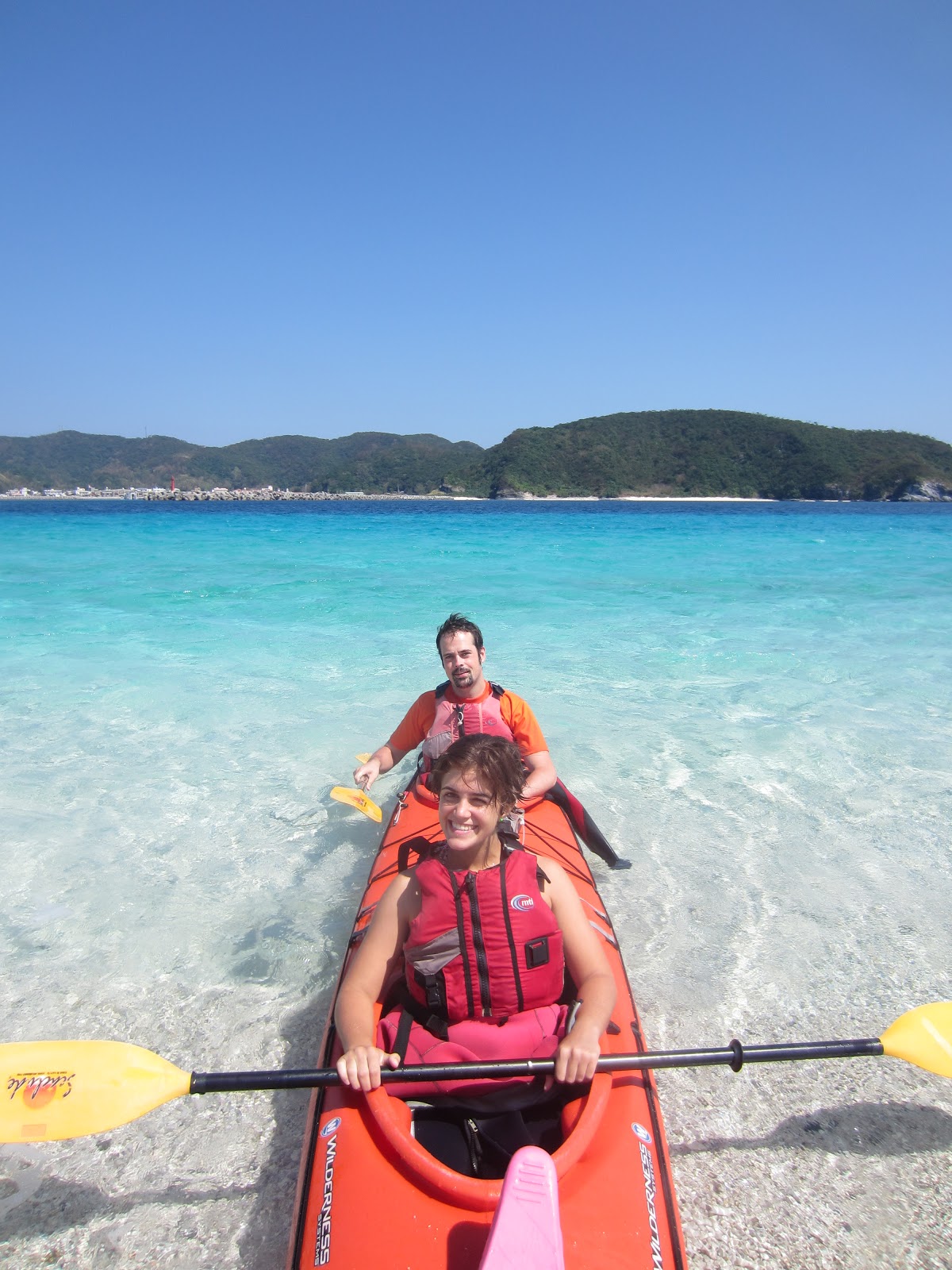
Next we kayaked to one of the uninhabited islands between two bigger islands and snorkeled in the corral reef. Our guide pointed out many cool creatures like a very fragile sea star and a very poisonous sea snake. The guide grabbed the sea snake by the head and tail and we got to touch it! It felt like a normal snake. Then when it was released, it swam right towards me! I guess it wasn't in the mood for any oodoriigui though. (Get it? My name is Japanese is pronounced oodorii, which sounds like the previous odori, but the vowels are longer. So I said he wasn't in the mood to eat any Audreys. Ha!) Other than the snake, I didn't get to touch any of the fish because they were too fast, but I did try.
We kayaked to another island, did some more snorkeling, wandered around while the guide cooked us some Okinawan spaghetti on the beach and went out again. The sun was warm, the water was refreshing and I spent the day chasing animals. Doesn't get much better!
 That night we were turned down at a couple restaurants because they were too full. We eventually found ourselves at this place that was definitely not one of the hip joints (out of the 5 other restaurants on the island). It was run by an old man, who couldn't provide half the things on the menu, but the menu was a little odd itself:
Notice the top line: "spit" and the second from the bottom "an oil painting"
 Day 4: The next day we headed off back to mainland Okinawa. The ferry first stopped at a neighboring island, Aka-jima. There's a cute story about two dogs, Marilyn and Shiro. Marilyn lived on Zamami, where we were, but Shiro lived on Aki-jima. The two dogs were in love, after meeting when Shiro was brought to Zamami on a routine visit. But it was love at first sight and legend has it that Shiro swam back and forth between the islands to see his beloved Marilyn. Cute right? There is a statue of each on their respective islands.
Back in Naha, we headed out Kokusaidori (International Street) to see a parade and the execution of the world's biggest tug-of-war. We saw some of the parade, ate some Mexican food, saw the GIANT rope, but got too bored of the waiting through hours of ceremony and preparation to watch the actual tugging, we wouldn't be able to see much anyway.


This event is a battle between two ends of town that dates back to the 17th century. I assume the rope wasn't as big back then, because they didn't the fleet of cranes needed to carry all 40 tons of it. Apparently, about 20,000 people participate and everyone gets to hold a smaller branch rope and pulls on that as men call directions from atop the rope itself. It was cool, but not as cool as I was hoping.
 Day 5: This was a big day too. We rented a car and drove up to the northern end of the island to the world famous aquarium. It was pretty awesome and I got to hold more sea cucumbers (which if I didn't mention above, I really like sea cucumbers (not eating them though, even though it's one of Omura's specialties). There was a humungous tank with huge fish and a shark. Really neat.
(On the way up to the aquarium we stopped at an A&W Burger for the most disappointing meal of the trip. But I think we hyped it up more in our heads than it warranted.)
 Next we went to the Nago Pineapple Park, which is indeed a tourist trap. It pretty funny though. We rode a magnetically controlled golf cart through a "botanical garden" as a tape told us facts like "pineapple comes from the words 'pine' and 'apple'." It was enlightening. I think we ate our admission fee in free pineapple samples though. We ate until our tongue burned and our stomachs ached. With full bellies, we were immune to the next tour of the gift shop where they offered everything from pineapple cake to pineapple wine to pineapple soap. The best (or worst...?) part of the park was the song that you heard constantly from the second you stepped out of your car until hours after you left, since you can't get it out of your head. I tried to find a good video so you could hear the song, but no luck. I'll sing it to you next time I see you.
One goal of ours for our trip was to find a mongoose v. habu (very poisonous snake) fight, that apparently used to be a thing. We playfully thought maybe there was an underground fighting ring we could somehow gain access too. While that didn't happen we did find a place that advertised fights, but since it has long been banned, was just a video. We didn't actually see it, so it's hard to say what it actually was.
 One very amusing moment for us was passing a sign board for the entrance of a college, but behind it was only a playground. This is funny because in Japan students work really hard to get in to college, but once they are there, they can relax and take it easy.
Day 6: Our last day on the islands. We took the car up to the Shuri Castle. This palace was burned down, rebuilt and renovated countless times, but it was still pretty cool. We watched a video of a renovation and it seemed pretty hard work; I can't imagine having to build, paint and decorate that place without modern technology.
Finally, we stocked up on souvenirs and hit the road back to Omura. It was a fun filled trip.
Okinawa is pretty much Japan's Hawaii. It has the reputation of having beautiful beaches and a rich, unique culture. You probably know the name from the WWII Battle of Okinawa (sometimes referred to as "The Typhoon of Steel"). This fight, was not only the last major battle, but also resulted in the most casualties, nearing 200,000 in military and civilian deaths.
After the war, the US signed a treaty with Japan basically saying that Japan isn't allowed to have a military (only a self-defense force), but the US will protect them. This resulted in over 36,000 US military and civilian personnel being stationed all over Japan, known as the USFJ, United States Forces Japan (2009 figures). US bases really are scattered all over the country, we even have a US Naval base in nearby Sasebo City. However, about 70% of all USFJ bases are located in Okinawa. While the post-war Okinawan community seems to tolerate the military, their presence is not necessarily desired, in fact many people want them out completely.
The woes of the locals regarding the military aren't completely unwarranted. Many of the air force bases are located very close to residential neighborhoods, but also the US military doesn't have that clean of a rap sheet either, when interacting with locals. (For example: http://www.guardian.co.uk/world/2012/oct/17/us-sailors-accused-okinawa-rape)
But anyway, back to my vacation. Well... not yet.
Okinawa, once called the Ryukyu Islands, wasn't actually even part of Japan until 1609 when it was invaded by a Japanese from the mainland. Being so far away however, they were pretty independent until they were officially made part of Japan after the Meiji Restoration, in 1879. Coming in so late in the game, Okinawa has it's own "dialect" which is actually more or less a completely different language and nearly incomprehensible to Japanese speakers. Mainland Japanese is taking over though, with Okinawan only spoken by the elderly and in traditional songs and performances. (I had no problem communicating). Okinawan music and dance is also much different than that of the mainland, having more influence from China and other Asian cultures. These other cultures can also be seen in the unique architecture of traditional buildings.
Okay, now you know where I went, let's talk about what I did.
 |
| Steve |
 | |
| The most sacred spot |
 |
| The most southern spot |
 |
| Pig's foot |
That night we ate some Okinawan specialties like pig foot, pig ear (in peanut sauce) and some seaweed stuff. The pig foot was not good, the peanut sauce on the pig ear made it very edible, only the texture was a little strange.
Day 2: The next day we took a ferry off the main island to an island called Zamami. It's a small island with about 3,000 people and consists mostly of hotel and restaurant owners, but every thing was almost run down. Our room was a single standing "building" that reminded me of those "Pods," portable storage containers- barely enough room for our fold out beds and the bathrooms a port-o-potty and a port-o-shower. It was still fun though.
 After arriving we rented some bicycles and cycled our way to some beaches, then up some mountains (oops). The scenery was impeccable. The water was a little cold, but little fish would come and swim up right next to us! Later we ended up renting some snorkels and masks and swam amongst some corral. Let me tell you, I don't know if I've done anything so cool, and it got better. We not only saw a sea turtle, but we got to swim right next to him! It was SO COOL. But again, it gets better, just wait.
That night, we had arranged to do a "mystery tour" with our hotel owner. The Mama-san came along too and brought their daughter who was visiting for the weekend from San Fransisco. The first stop was a spot to view fireflies, we didn't see many though. Mystery number two was at the port. Armed with flashlights and nets we were instructed to shine the light into the shallow water to attract plankton. The plankton would attract these little fish, which were supposed to catch. I followed the directions and found that I was surprisingly good at catching this fast little suckers. So I caught one and I was just excited for catching it. I thought that was that. Then they brought out the container of soy sauce and ginger. What?! Somehow I'd missed the part where we told we were going to eat the fish. I put the still live fish in the soy sauce and it kept flopping around until, crunch! I chewed him to death! In Japanese it's called 踊り食い odorigui (踊り means dancing and 食い is eat). So I ate the still dancing fish. Pretty wild right? It tasted bad, very very fishy. The next mystery was just a couple feet away in another shallow part of the port. Here we used the nets to stir up some bioluminescent plankton, but I didn't eat these guys. Next up was another dock were we caught two fish (again, everyone was so impressed by my net skills), one rare one that looked like a leaf and another that had a long nose. Second to last was the hermit crab lair. There were about a hundred hermit crabs walking around a giant pile of shells. We played with them a bit and then saw one change shells, which apparently isn't seen too often. (Steve later found this article http://newscenter.berkeley.edu/2012/10/26/hermit-crabs-socialize-to-evict-their-neighbors/). The last mystery was the most spectacular. We drove up to the top of a a big hill and laid down on a helipad and gazed at the stars. I saw the milky way!
Day 3: The next morning we headed out for another fantastic day. With a blue sky, a wet suit and snorkel gear we first swam with some sea turtles, no big deal. Just kidding, it was a big deal! We followed around this big daddy turtle for awhile and then a little guy came over too. It was AWESOME! Our guide (for this sea kayaking/ snorkel tour we were doing) took a lot of pictures of us.
 |
| Me and a sea turtle |
 |
| Kayaking |
Next we kayaked to one of the uninhabited islands between two bigger islands and snorkeled in the corral reef. Our guide pointed out many cool creatures like a very fragile sea star and a very poisonous sea snake. The guide grabbed the sea snake by the head and tail and we got to touch it! It felt like a normal snake. Then when it was released, it swam right towards me! I guess it wasn't in the mood for any oodoriigui though. (Get it? My name is Japanese is pronounced oodorii, which sounds like the previous odori, but the vowels are longer. So I said he wasn't in the mood to eat any Audreys. Ha!) Other than the snake, I didn't get to touch any of the fish because they were too fast, but I did try.
We kayaked to another island, did some more snorkeling, wandered around while the guide cooked us some Okinawan spaghetti on the beach and went out again. The sun was warm, the water was refreshing and I spent the day chasing animals. Doesn't get much better!

Notice the top line: "spit" and the second from the bottom "an oil painting"

Back in Naha, we headed out Kokusaidori (International Street) to see a parade and the execution of the world's biggest tug-of-war. We saw some of the parade, ate some Mexican food, saw the GIANT rope, but got too bored of the waiting through hours of ceremony and preparation to watch the actual tugging, we wouldn't be able to see much anyway.


This event is a battle between two ends of town that dates back to the 17th century. I assume the rope wasn't as big back then, because they didn't the fleet of cranes needed to carry all 40 tons of it. Apparently, about 20,000 people participate and everyone gets to hold a smaller branch rope and pulls on that as men call directions from atop the rope itself. It was cool, but not as cool as I was hoping.
 Day 5: This was a big day too. We rented a car and drove up to the northern end of the island to the world famous aquarium. It was pretty awesome and I got to hold more sea cucumbers (which if I didn't mention above, I really like sea cucumbers (not eating them though, even though it's one of Omura's specialties). There was a humungous tank with huge fish and a shark. Really neat.
(On the way up to the aquarium we stopped at an A&W Burger for the most disappointing meal of the trip. But I think we hyped it up more in our heads than it warranted.)
 Next we went to the Nago Pineapple Park, which is indeed a tourist trap. It pretty funny though. We rode a magnetically controlled golf cart through a "botanical garden" as a tape told us facts like "pineapple comes from the words 'pine' and 'apple'." It was enlightening. I think we ate our admission fee in free pineapple samples though. We ate until our tongue burned and our stomachs ached. With full bellies, we were immune to the next tour of the gift shop where they offered everything from pineapple cake to pineapple wine to pineapple soap. The best (or worst...?) part of the park was the song that you heard constantly from the second you stepped out of your car until hours after you left, since you can't get it out of your head. I tried to find a good video so you could hear the song, but no luck. I'll sing it to you next time I see you.
One goal of ours for our trip was to find a mongoose v. habu (very poisonous snake) fight, that apparently used to be a thing. We playfully thought maybe there was an underground fighting ring we could somehow gain access too. While that didn't happen we did find a place that advertised fights, but since it has long been banned, was just a video. We didn't actually see it, so it's hard to say what it actually was.
 One very amusing moment for us was passing a sign board for the entrance of a college, but behind it was only a playground. This is funny because in Japan students work really hard to get in to college, but once they are there, they can relax and take it easy.
 Day 6: Our last day on the islands. We took the car up to the Shuri Castle. This palace was burned down, rebuilt and renovated countless times, but it was still pretty cool. We watched a video of a renovation and it seemed pretty hard work; I can't imagine having to build, paint and decorate that place without modern technology.
Finally, we stocked up on souvenirs and hit the road back to Omura. It was a fun filled trip.
Sunday, September 16, 2012
Takoyaki Party
Following the gyoza party, I had a takoyaki party with some other friends. This time, instead of dumplings we made takoyaki (literally grilled octopus, but it's more of a clump of dough with a small piece of octopus in the middle). Since I'm not the biggest fan of octopus, we used wieners instead, which were delicious!


 At the end we played "Russian roulette." We put kimchee in one, peanut butter in another, and mustard in another. Then we mixed them up with normal ones and took turns eating. It was fun. I lucked out with a normal one, but I tasted the kimchee, it was great!


Gyoza Party
Last week, I had a couple of Japanese friends over and we made gyoza. Well, they made the stuffing, I just stuffed and sealed the pouches. You can buy the gyoza skin in the supermarket, so it as all pretty easy.

 My friends also brought some pizza stuff so we made pizza gyoza. Their version of pizza gyoza was not what I had in mind though. When they suggested it, I was thinking "pizza roll", but they just made them flat. While those were delicious, my specially made pizza roll style was perfect. It was no pizza roll, as I didn't have real pepperoni, cheese or grease, it was delicious.


Termites
Termites- in Japanese, 白蟻、or white ant.
I had termites! One day I was vacuuming and found this really weird dirt-like crud under a floor chair (see below). It was gross and weird. Thankfully, the same day the apartment maintenance guys were next door and came to take a look. They took one glance and instantly knew- termites.


 They pulled up the tatami and thousands of little termites were crawling around eating my floor! They were quickly cleaned up, medicine was put in and the tatami mats were put back. That was that. No tent. No fumigation. So far so good, no more termites.
I had termites! One day I was vacuuming and found this really weird dirt-like crud under a floor chair (see below). It was gross and weird. Thankfully, the same day the apartment maintenance guys were next door and came to take a look. They took one glance and instantly knew- termites.


Subscribe to:
Posts (Atom)